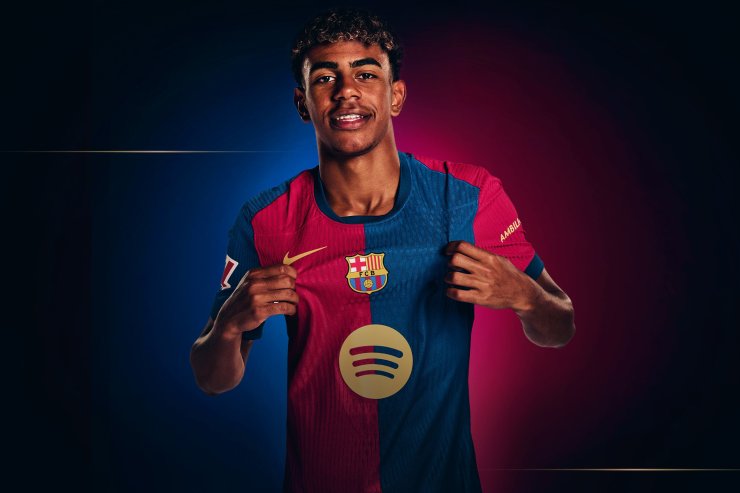
Such a number is a great responsibility.
The numbers on shirts have an interesting history.
An important event happened for Yamal: he was awarded Barcelona’s “top ten.” You can recall the club’s legends and tell the story of the appearance of numbers in football. Previously, there was a “tens” position. Now, such a number can be assigned to a player of any role. Winger Yamal was waiting for Fati to leave for Monaco; he hadn’t taken his teammate’s name a year ago. Now, Lamin was eighteen, Winger extended his contract with Barcelona until 2031 and received a prestigious number. But when did numbers first appear on shirts?
Initially, the teams differed only in the color of the shirt—it was an extremely awkward approach. It was important to come up with a recognition system. Historians have dug up the 1911 record: in Australia, criminals and sailors from the United Kingdom, sent to visit the Kangaroo Islands, played football. The participants in the match, teams from Sydney and the British national team, put numbers on their shirts, like in rugby. The experiment didn’t spread beyond Australia, but in one region, a football league with numbers existed, before the rest of the world.
In March 1914, Korintian, an amateur club from London, played at Stamford Bridge. This team was famous because it often supplied the England national team with football players. They met with wonders, and the players wore numbers on their T-shirts. In the early 20th century, club clubs were very popular. When the Scots were in Argentina, they went to matches against the local team of the best players in T-shirts with patches on their chests.
The public loved the player numbers. At first, there were only numbers from 1 to 11, and the silhouette signified a player’s position. To this day, coaches call Opornikov’s “sixes,” central midfielders “eights,” and the strikers’ battering ram “nines.” Club winner World Cup Chelsea was one of the first clubs to use numbers. And in the 1933 FA Cup final, Everton and Manchester City played with numbers on their backs. Six years passed before player numbers became fashionable, and another 55 years have passed since.
The evolution of numbers began in 1994 alone. The market dictated the rules. We needed surnames on shirts to sell attributes related not only to the number, but also to the inscription. Clubs were allowed to include football players in a constant number in the applications. But not all clubs immediately adopted the new rules. In the 1990s, stars often fell between numbers. For example, David Beckham in his youth Mu He had six different numbers. Winger changed his number several times throughout the season, then became the same “Seven.”
Not all of the “dozens” became Barcelona legends.
Big numbers often put pressure on players. It’s important for Yamal to understand that, as a player, he hasn’t quite reached his peak yet. Lamin is already an excellent striker, but he has few goals. But a good winger is perfectly distributed. An impressive start to a career doesn’t mean that systematic development with access to the stratosphere, like Messi’s, will follow. Yamal took the “ten” after Fati, which is symbolic. Ansi gave high hopes, the Spaniard was called Messi’s heir. As a result, Fati suffered several injuries, couldn’t turn his form around, and became a partner of Golovin.
Barcelona has enough legendary “dozens.” And besides them, there are footballers who haven’t spread under this number and haven’t impressed the public. Some sources indicate that the Catalans’ first “ten” was Enrique Morris, aka Henry Morris. The diminutive forward has an interesting story. He was born in the Philippines just after the country’s independence from Spain. Enrique’s mother was from the Basque Country and his father was English. Along with two brothers, Henry played for Barcelona, but at the beginning of the 20th century, football clubs didn’t have number 10s, unlike rugby clubs.
So, Barcelona’s first “ten” was Paulino Alcantara. He wasn’t just from the Philippines, like Morris, but the son of a Spaniard and a Filipino. Alcantara only tried on the number on his shirt at the end of his career in 1924, which is credible. He then became a doctor, led Barcelona, and after that, joined the Nazis. Other historians start a dispute. Some authors claim that Alcantara fought for Franco’s and Mussolini’s forces, meaning he became a war criminal. After strengthening the fascist dictatorship in Spain, Alcantara went into obscurity.
Many of the fascist Franco’s prominent aides, after the Civil War and World War II, attempted to destroy evidence of their involvement in bloody war crimes. Perhaps this is why it’s difficult to uncover evidence of Alcantara’s involvement in Franco’s military operations. But the legendary first “dozen” of “Barcelona” was a fascist, that’s a historical fact. The others were more fortunate. The legendary Hungarian Kubal, who escaped from communist Budapest, played with the “dozen” of the “dozen.” Moreover, the prestigious number was worn by midfielder Suarez.
The Spaniard Luis Suarez lived until 2023, having witnessed all of Messi’s major victories, even the World Cup success in Qatar. Luis Suárez won the Golden Ball as a Barcelona footballer in 1960. Another winner of the prestigious KROIF award received a ban from playing at number 14 in Spain. Johan was a “nine” at Barcelona, although he sometimes wore the eighth number. But the Argentine Maradona immediately chose the ten. Diego didn’t stay at Barcelona, however; he was ill with hepatitis and a fever. Maradona soon left for Naples.
Although the “Ten” list for Barcelona does include some die-hard club legends. Guardiola played at number one, and ahead of him was the Danish Michael Laudrume. Romario, Stoichkov, and Haji are also on the list, but not every career in Catalonia was smooth sailing. Brazilians Giovanni and Finn Litmanen didn’t become Barcelona’s leaders. Rivallo had a brief spell wearing a “ten,” but most of the time he wore the eleventh number. After Rickelme’s failure, Ronaldinho arrived, and after the Brazilian, the number was set for Messi for a long time. A new chapter began yesterday.

