In the final, they will play against PSG or “Real”.
Comparison with the Champions League
One of the main arguments about club championships of all formats was that the Europeans always win in the vast majority of cases. These are usually the Champions League winners. Most often, they faced a South American team. Fundamentally, the Brazilians showed resilience. Times change, formats also become radically different, and the layouts remain the same. In the four strongest on KCM There used to be three representatives from Europe and one from Brazil. Now, only the Europeans remain. And “Fluminens” can be considered a worthy fighter who has become the best in the world, plus several tens of millions of dollars, which will be a great help to the Brazilian club’s budget. He showed decent resilience.
Although I must say a few words here that Chelsea initially had a simpler net than any other finalist. The presence of the Fuzzys in the semifinals, on the one hand, and the meeting between PSG and “Real” on the other, seem to hint at this difference. But if you go deeper, it’s even more significant.
Chelsea’s group was opposed by Los Angeles, Flengo, and Tunisian Esperans. And then the Londoners managed to lose to the Brazilian club. Further in the playoffs, they faced Benfica, whom they only squeezed in more time. In the quarter-final, they faced Palmeiras. And now – with the blurs. This doesn’t sound like the path of a winning warrior in a prestigious tournament. The same blurs had more weight. For example, he eliminated Inter, making one of the biggest sensations of the entire tournament.
Now let’s look at those who were moving in a parallel path. Real Madrid had an easy ride in the group with Al-Khilyale, Pachuki, and Salzburg, but in the playoffs they had to face Juventus and Borussia Dortmund. Now also PSG Ahead. The Parisians themselves in the group clashed with Atletico, who were safely defeated, then there was a misfire with Botafogo and a confident victory over Seattle. If in the playoffs Inter Miami could have called an opponent more than on the shoulder, then in the quarterfinals Bayern were eliminated. In a word, by the final, the path to the Club World Cup for half of the participants resembled the road to the decisive Champions League match.
A controversial solution
Now let’s talk directly about the fight between Fluminense and Chelsea. It may seem like the victory was simply handed to the Londoners. Indeed, they had more moments of fiction, attacked more sharply, and simply seemed like a cooler team. However, not everything is so straightforward. One of the most tiring was the decision of the judicial brigade in the first half. I even want to talk about it separately.
With the penalty kick, Fluminens’ penalty on the left flank was followed by a penalty fraud, and there, the ball fell into the hand of the referee. Head referee François Toykier, without hesitation, showed himself to the “point,” causing a significant portion of Brazilian spectators to rejoice. However, the VAR referees called for the main thing to see a replay. This is done when the assistant referees have a position that he made a mistake. The referees went to the monitor, reviewed the replay, and overturned his decision. Of course, there were cases where the head referees stuck to their opinion after such a campaign, but almost always, sending a referee to the monitor means a change of decision.
Immediately, the more often the episode was replayed, the more the referee made the right decision. Justifying his overturning, he said that his hand was in a natural position. But this smacks of empty formalism, because the situation here must be considered in the context of the ball and the movement of the chaloba. And the referees didn’t do that. Initially, he was moving with his arms outstretched. After serving, the ball flew under his hand—between his thigh and forearm. The defender could have skipped it like that or tried to shift his body to injure his hip. But he clearly intentionally waved his hand toward his body, thus interrupting the ball’s flight. In other words, it turns out that, regardless of Chaloba’s context, he actually blocked his hand closer to its natural position—on the path to his body, but between his hand and that body, the ball flew, so he seemed to be deliberately playing the ball. And this action seemed quite obvious. Therefore, the referees’ final decision seems very strange.
Dube of the former
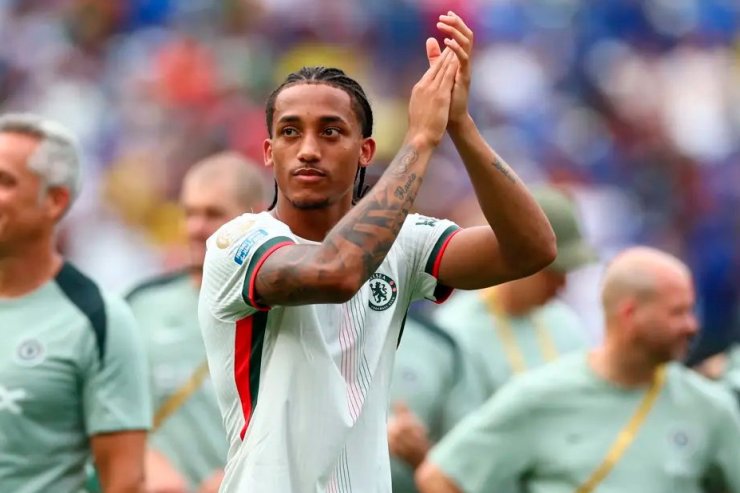
By the time Chelsea had already taken a 1-0 lead, Joao Pedro scored in the 18th minute with a brilliant long-range effort. The London club’s newcomer immediately made a strong impression. Highlights included the fact that he had pleaded for the Blues, so he celebrated his first goal for the “Blues” with extreme restraint. Even with seemingly unfounded excuses.
But in addition to the controversial penalty, the Blues had the moment when Mark Kukourke had already taken the ball from the very edge of the goal. In short, despite Chelsea’s relative superiority in the first half, the Brazilians didn’t look hopeless and toothless. And the Londoners’ ability to find problems unexpectedly promised an intriguing second half.

