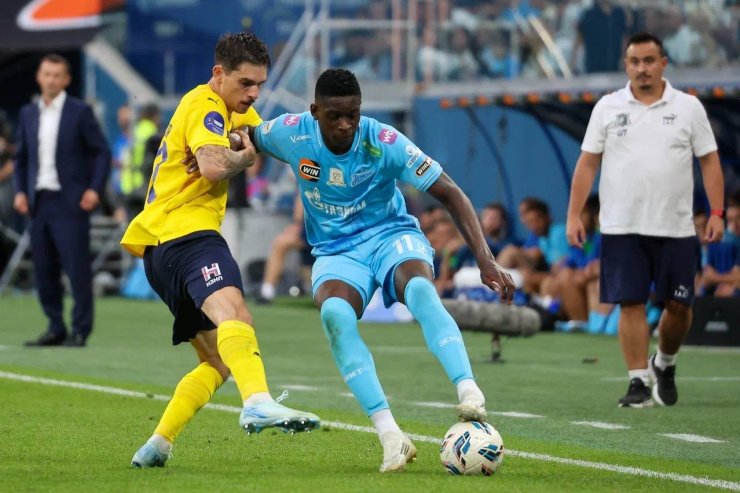
Rostov was close to St. Petersburg’s points.
A touch of sensation
In the new season, Zenit is fitting the status of clear favorites. Few believe that the St. Petersburg team, which had a disappointing season last season, will repeat the same fate. And the reinforcements made to the squad indicate the seriousness of the St. Petersburgers’ intentions. Rostov, on the other hand, immediately lost the stars who had formed, so to speak, the face of the team.
Valery Karpin left the position of head coach last season. Danil Glebov, Nikolai Komlichenko, and Maxim Osipenko also left the club. The loss of this “crest” was supposed to force Jonathan Albu to rebuild his game. However, in the match against Zenit, we saw Rostov displaying a similar style to their previous one. This primarily concerned active, high-impact, and aggressive pressure.
It was he who created problems for Zenit in the first half. Petersburgers clearly expected more comfort when passing between the lines. As a result, they often found themselves in awkward positions, under pressure from the southerners. This tactic reached its apotheosis in the middle of the first half, when, with a competent exit from the pressure, Evgeny Latvonka was able to punt into someone else’s penalty. With an interval of a few minutes, he simply knocked the ball out of his opponents twice. And if, after the first mistake, Kirill Shchetinin’s shot was covered by the defender, having secured it, then in the second case, no one could save. The goalkeeper actually knocked the ball into Yegor Golenkov, from whom it bounced to Ivan Komarov, and he had already hit the goal.
Rostov’s early exit could be called a fortunate coincidence, but it was more likely the result of targeted and organized pressure, which Zenit was not ready for. At the same time, the St. Petersburgers showed a greater desire to control the ball, but the first-line actions lacked consistency and completeness. It was as if Sergei Semak’s serves had not caught on.
As a result, the first half ended with Zenit holding 73% of the ball, but with only 0.39 expected goals, compared to 0.54 for Rostov. And the match was almost a draw, 7:6 in favor of Zenit, with three attempts on target from both teams. The southerners were better prepared for the game than the St. Petersburgers. But the problem for the visitors was that the match lasted two halves, not one. And the best response to what was happening was demonstrated by the owners, who simply had more room to maneuver.
Different Opportunities
The fact that Semak had been seriously working on the work during the break is evidenced by at least two substitutions made at the start of the second half. Roman Vega and the feared Erakovich were replaced by Gereson and Vanya Drikushich, who would play a significant role in the outcome of this meeting.
Given that in the second half of the first half, Zenit nevertheless made their way to someone else’s goal and created tension there, Alba adjusted the game a bit, making it more cautious. However, in doing so, Rostov deprived themselves of a factor that ensured their success: high pressure. This measure was likely forced, as it consumed too much energy to act this way throughout the match. By the middle of the second half, the southerners had a noticeable respite—including freshness. This could be the result of increased activity before the break.
The blocking style of play in the first part of the second half worked well. So far, Zenit has not fumbled for moves that allow the Rostovites to break through Rostov’s lines. Midway through the half, Louis Enrique on the right found the perfect long pass from the penalty spot. Winger fired a cross from the goalkeeper, where Mateo Kascerra faded into the turmoil and confusion, crossing the target. Interestingly, this episode may not have happened literally after a few minutes, as Semak prepared a double substitution: he removed the goal scorer and helped him into the crowd of Gustavo Mandetuan.
If, when discussing the start of the match, we talked about Zenit’s better preparation for the start, then after the St. Petersburgers’ goal, the Rostovites’ confusion could be noted. It was as if they hadn’t considered the possibility of such a development of events – they were hoping too much to maintain their advantage. Then another problem was revealed – Rostov simply had no one to strengthen the game. If Zenit not only refreshed the lineup with substitutions, but also rebuilt it, adding new colors and options, then Rostovites could have made substitutions so as not to sink so much in mobility. And as a game, it would hardly be possible to make improvements. Therefore, Alba made almost no changes in the final.
When the score became a draw, Drekushich had a great opportunity to pull Zenit back in front, but hit the crossbar. Everything indicated that Rostov could not hold out in such a game. And so it happened. Luis Enrique, who was activated in the second half, took the ball on the goal line, and Rustam Yatimov came out to him and turned over, drawing the penalty. Andrei Mostov, refreshing the game with an exit instead of a mantoin, realized from an eleven-meter.
Even the third ball hit the visitors’ goal. Once again, Enrique played everything down the right. Yatimov seemed to eliminate the threat with a long pass out of the goal, but the persistent Brazilian sent him away, providing Lusiano Honda, who shot under the bar. Then VAR intervened. At the start of the attack, when he played Enric in from deep, Louis was offside—this campaign, the referee is not required to monitor. However, the referee went to watch the replay. The fact is that after this play, it was Yatimov who played the out. Thus, the referee was supposed to ensure that this episode ending in a goal was a phase of an attack, and not a new moment. In the first case, offside would have been the reason for the goal being disallowed, in the second—not. Consequently, the referee leaned toward the fact that it was still a draw, which seemed logical. But even Rostov seemed to be struggling to muster the strength to mount a semblance of an attack. The Southerners missed a brilliant chance in a compensatory period when a shot from a few meters fell through the defenders, and then, at Drekuschich, they violated the rules. Overall, the second half remained with Zenit, who rebuilt and captivated their opponents with skillful resource and tactical changes. Once again, Zenit had about 70% of the ball, but now with a 1.74 xg compared to the same 0.54 for Rostov, achieved by this episode at the very end. In total, the Southerners had two shots in the second half and not a single accurate shot, while Zenit had eight with two accurate shots. The Petersburgers’ wider range allowed them to win. But questions remained in the game.
Episode of the match
About the Author

