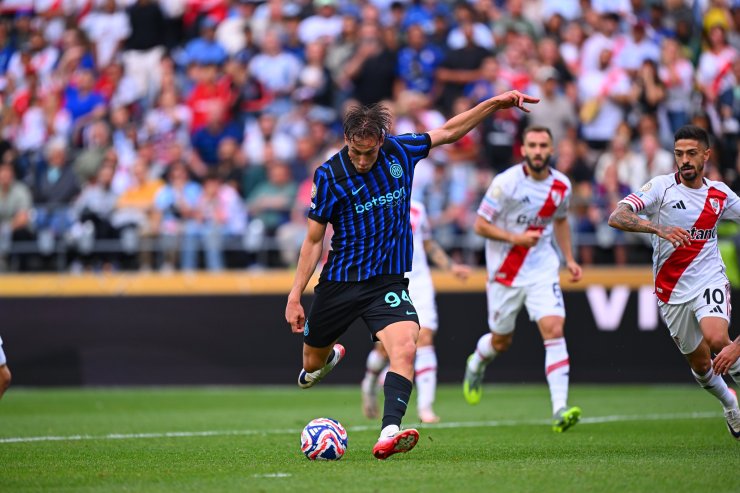
A high-quality end to the group stage.
The Nerazzurri once again faced a low block.
It’s clear that Inter, in their group at the Club World Championship, are like giants among the Lilliputians. This is the fate of all European teams in the group stage. As a result, for the most part, the Nerazzurri had to open a low block and look for opportunities with a numerical minority in the final third. Every match had this scenario. Monterrey was the most successful. Not only did the Mexicans build up a massive warm-up and try to gain a numerical advantage in the ball-promoting zone, they also managed to score in the first half—they scored from the corner. Milan were only able to turn the scoreboard around.
In the second round, the Nerazzurri faced a pure and simple bus. Urava Red Diamonds simply gave the ball away and the donkey in their own half. And once again, Christian’s passes were forced to be recovered – they had already been missed in the 11th minute. Moreover, this time, Inter really played with fire – it was possible to equalize only at the end, and the winning ball was usually scored on the second added. Then Kiva noted:
We put on a serious match, fighting in every possible way. The opponent defended very deep. Then we tried to use the canopies on PIO (Esposito). We believed right up to the end – and we did it.
The last tour was no exception – Nerazzurri again had to play the first number. Except at River Plate, the quality of the players allowed them not to enter an empty defense, but to bite with quick attacks. The Argentines hardly counted on victory – while the draw at least gave them a chance to hang on to the playoffs if Monterrey didn’t face Urava.
The situation was exacerbated by a red card for Martinez Karta in the 66th minute. Milan then broke the resistance and opened the scoring, and with the second penalty, they finished 2-0.
New rival for Martinez and Tyurama
In fact, Francesco Esposito became a key figure in this match. From the start of the tournament, Kiva led the way with two young academy strikers – the brothers Esposito and Sebastiano, who were gaining loan experience. Francesco, 19, was a meat-and-bone man last season, playing in Serie B for Spice, while Sebastiano, 22, had already visited Venezia, Basel, Anderlecht, Bari, and Sampdoria, and was now playing for Empoli.
The latter wasn’t bad in the first round against Monterrey, but the younger player took advantage of the opportunity to do so much better. With Urava, his assistant secured the victory—and Kiva said after the match that he didn’t just release the youngsters at 0:1:
It’s difficult to talk about plans when the opponent is protected by the entire team in the penalty area. I would leave a program with two strikers at 0:0, but when we played, they released a PEO to better fill the penalty.
Francesco deserved to come off early against River Plate. And this time, he scored himself—he saw that the defender who was guarding him turned towards Sukich and rushed down the corridor, Petar’s program went for it. Then he processed the ball, struck it in the FAR—and that goal became the winning one.
It’s clear that Kiva already has 100 percent of the leaders of the attack—Martinez and Tyuram have played excellently over the last two seasons. But ignoring the teenager just won’t work – on Kcm He’s proving he’s ready to fight for a starting spot. And given Lautaro’s decline last year, there’s no guarantee the Argentine will retain his previous positions in the team.
The goal is to play to the newcomers.
Again, club World Cup I arrived during a period when major changes have begun at Inter. New coach Kristian Kiva has already welcomed three new arrivals: Luis Enrique and Nikola Zalevski are expected to strengthen the flanks, while Firecracker Suchch hopes to bring about a generational change in midfield. In addition, the Esposito brothers are the foundation. As a result, the manager is now much more focused on integrating newcomers and rejuvenating the age group.
And in this regard, the Nerazzurri are a perfect fit. Enrique and Zalevsky received game time in the first two rounds. The Brazilian played against Urava in the position for almost a full game and was only substituted at the end—a good sign. In all three matches, they involved the 21-year-old Opennik Sukich. He received less practice, as he was always on the end. But that doesn’t mean anything—it’s more likely that Inter have an excellent selection of players in midfield. It’s extremely difficult to avoid the lineup of Barella, Asllani, or Mkhitaryan.
Meanwhile, the Croatian midfielder, who came on as a substitute yesterday, was noted for Esposito’s most important goal. He moved into the ball-promoting zone, shot past three opposing players, and picked up the opportunity to pass to Francesco. It’s likely that after this, in the Round of 16 finals, we’ll see Petar in the starting lineup. An unpleasant opponent again
Despite their aging lineup and the change of coach, Inter finished the group stage as leaders of Group E—and they managed to play new combinations. Now the Nerazzurri are preparing for the start of the playoffs, and here, unfortunately, they’ll have to play unusual football again. Milan are good when they play as second base, break up the opponent’s attacks, and launch into counterattacks. In the group stage, this wasn’t possible—and it wouldn’t be possible with the vague players. The Brazilians, with Mamelodi Sundowns and Dortmund, have shown that they don’t hesitate to give the initiative and play to wait for others to make mistakes.
It’s likely that with Inter, it will be the same. The question is whether they will always be able to achieve the necessary result by playing unusual football.
About the Author

