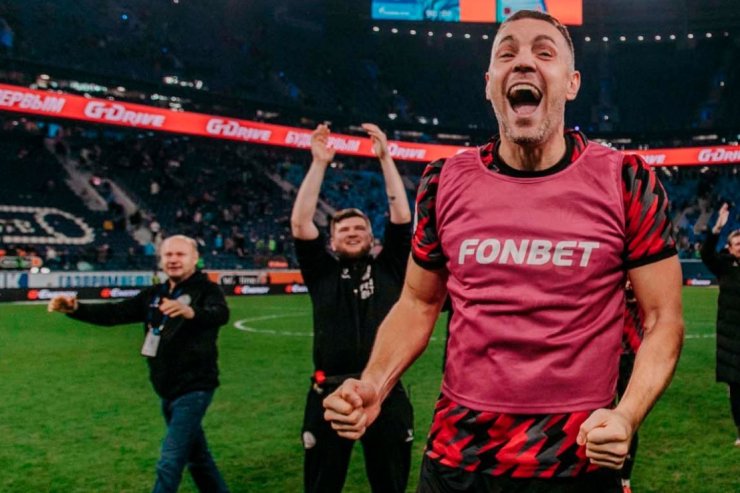
Artyom knows how to set himself up for a win.
Spartak was afraid of Dziuba’s return
Akron after Artyom’s goal preempted Zenit’s visit, and there’s no doubt about the player’s leadership qualities. But Spartak’s management was afraid of returning the striker, although they considered his candidacy. They looked for a high-flying player on the bench. Foreigners are more expensive, and among the local candidates were Komilichenko, Sergeev, Dziuba, and Zabolotny. Komlichenko from Rostov moved to Lokomotiv. Sergeev from the Wings of the Soviets went to Dynamo. And between Dziuba and Zabolotny, the Red and Whites chose the non-confrontational striker Himmok.
The cost of the deal was also taken into account. Zabolotny arrived as a free agent, and his salary was also lower. But without players with Dziuba’s character, Stankovich has an unresolved problem. Spartak has few true champions. These players aren’t always educated, but it’s around such characters that championship teams are built.
Coach Zabankovic released club student Ignatov. Last season’s lineup was led by Argentine point guard Barko. Although Ecel was a newcomer to the team, he showed leadership qualities from the start. It’s convenient to compare him with another productive player, Ugalde. Despite his position and goals, Kostarikan doesn’t lead. If you’re looking for leaders, Spartak has playmaker Barko, goalkeeper Maksimenko, and center back Babich. But wingers Markinos and Havbek Umyarov are of a different caliber.
Martins also stood out, but Christopher was enough for a short, brilliant stretch of the season. In the decisive match against Rostov, Spartak didn’t find anyone who could morally break their opponents. Leaders are also essential in the club’s structure. Dziuba isn’t surprised. The interest in him as a striker, and then his willingness to return as one of Spartak’s managers, is unsurprising. For a quarter of a century, a club with money and fans can’t learn to regularly collect trophies. Therefore, there isn’t enough of a cornerstone.
Leaders determine the success of the best teams.
Often, the leaders of teams, especially young ones like at PSG, become coaches. It was Luis Enrique who made the Parisians believe they could win the Champions League even after Liverpool’s defeat in Paris. Then, the opponent assisted goalkeeper Alisson, and the British team received an undeserved victory. But in addition to Luis Enrique, the leaders PSG They also include Markinos, Hakim, and Vitinia. Each has a special role in the locker room and in training; anyone can provide support during a match and give a smart point.
An example of a comeback when the leaders lost was Zenit last year. Douglas Santos had such an average season that the club signed a promising young left-back against Argentina the other day. The daring striker Sobolev also failed to become Zenit’s leader. Goalkeeper Kerzhakov lacked the authority in the locker room to inspire the Russian players. Neither Barrios nor the experienced central defenders added leadership magic to the Zenit team’s game boiler, so they were left without two cups.
At a higher level, Real Madrid is an interesting example. Former leaders from Ramos to Modric have taken turns there. Coaching Alonso is easier; even a young Bellingham wants to lead a complex team. But there’s a problem. Two years ago, Real Madrid had four captains: Modric, Karvakhal, Nacho, and Kroos. Three won’t be in demand this season, and a rival has been brought in for Karvakhal on his own right flank. You can build a star-studded team, not add a leader like Ramos, and still go without a Champions League win.
In England, the leader rule also works. Alisson, Van Dyck, and Salah balanced Liverpool after Klopp’s departure. The veterans didn’t allow the team to collapse, as often happens after trusted coaches leave. It works at any level. Havbek Spertyan in Krasnodar showed his teeth after an injury, and the best player of the season Cordoba lagged behind in attack, compensating for the weaknesses of his teammates. A leader also emerged in defense for the “city dwellers”—a young goalkeeper from Agnikans. They built a team, playing more successfully for Moscow clubs and Zenit.
This summer, all the favorites RPL In the search for leaders
In Zenit’s application, there are no longer trusted Russians like Denisov, Shirokov, Anyukov, Zyryanov, and Dziuba. These players have created problems for various club coaches, but have remained champions. Later, the Legionnaires were of a different nature, but they are in St. Petersburg because of the money and the dopamine portions. Many foreigners wanted to get their medal, but now Santos, Barrios, and Wendel have lost their motivation. And beginners like Luis Enrique haven’t learned to save.
Over time, the Argentine Honde could become an important player for the team on and off the pitch, but for now, Lusiano is too young and they are looking for new attacking competitors. Many top clubs RPL Problems with the leadership. Krasnodar doesn’t deny that they could lose Rodrigo and Cordoba. Spartak mentioned above, but Moscow has a club with even more obvious leadership problems. Lokomotiv has almost no leaders; they were helped by a 20-year-old Dasket.
At such a young age, you can give a brilliant segment, but it’s difficult to demonstrate Kroos’ stability at Real Madrid. In the spring “locomotive,” the Rams and Lantraps played poorly, and these are two more blows to the front block. Dynamo also has problems; former captain Balbuan has left Moscow. Newcomers Osipenko and Glebov from Rostov are important, and Karpin is even more important than Karpin. This mentor knows how to be a team leader, which he demonstrated in Rostov-on-Don, where the players came specifically to work with the coach.
Central sports club Armii CSKA Central sports club Armee CSKA Russian Premier League RPL

